Saturday, March 24, 2012

"Batman", "The Dark Knight", "The Guy Who Broods a Lot".


It’s no secret to anyone who knows me that I’m an avid comic book fan, partial to DC and even more partial to Batman. He is one of the most celebrated characters in popular culture and fiction, and is my favorite superhero of all time. While I make it an obligation to keep up with comic book lore, my introduction to Batman came from the 1989 Tim Burton film and the Animated Series. From there, I was able to immerse myself into the source material. Now, the following discussion was sparked from a debate I had with other film club members at my college. It was a debate of credibility toward the Christopher Nolan Batman films, which I personally enjoy. I had heard similar arguments in the past, from the Nolan films being good films on their own but poor Batman films in the same regard, to the Burton films being superior, to all of the live-action adaptations being poor. These discussions stuck with me and I thought about it on a deeper sort of level afterwards. One of the points raised was the misinterpretation of the Batman mythos in the way it’s represented in the films.

The thing you have to know about American comic book characters like Batman and Superman is that they have been tackled by hundreds of writers, each one bringing credibility or faults, and putting in their own two cents on what they feel Batman is. The lore is not really a singular consciousness with a grounded and upheld canon, aside from a few things. Those few things are crucial, yes, but it’s more an unspoken agreement rather than a contract. What I learned many years ago is that Batman belongs to culture, and everyone has their own interpretation of what he should be, what his art style should be akin to, and how Gotham should look. I’ll be perfectly honest; I’ve never been a fan of the camp state the character had been stuck in throughout the Silver Age of Comics as well as the 60s TV series. Getting colloquial for a second, just for the record, Adam West is epic. Besides, while I personally don’t care for the show, that doesn’t mean I don’t appreciate or respect it.

However, thanks to the efforts of Frank Miller (before he became a misogynist hack); Batman: The Dark Knight Returns chronicled a long-retired Batman returning to the fight in an even more dystopian and corrupt Gotham City. Stories like this coupled with the Tim Burton films helped push the idea of Batman being a more serious character to the public. The Burton films are inaccurate to the source material in many ways, most notably showing Batman kill thugs. However, in the defense of the Burton films, while not entirely true to the comics, they were aesthetically fantastic, and offered a well-deserved sense of gravitas for the character and legend on the big screen. Like numerous novels and other forms of literature in the past, people have to understand that film is a different medium, and therefore a different beast altogether, where changes have to be made. Did you expect Hollywood to get it right immediately out of the gate?

In the case of the Nolan films, he wanted to ground his adaptation to a greater degree of realism than had been done before, at least for live-action. The idea behind the Nolan trilogy (The Dark Knight Rises being a few months from release at the time of this review) is to make Batman seem like a palpable individual who could exist in our own world, which works from a dynamic standpoint as well as the idea behind Batman in the first place. The point of the character is that he has no superhuman traits; he has to rely on his physical and mental capabilities. Therefore, in a cinematic adaptation, it’s not only smart, but preferred by many a fan to go in this direction. Not only that, but Christopher Nolan is one of the greater filmmakers in the modern industry in both writing and directing respects. On top of that, David S. Goyer (an avid comic book fan) helped write the story with Nolan and his brother Jonathan, instilling elements from Batman: Year One, and other popular stories, Batman Begins was not only extremely faithful, but also fresh and unexpected considering the new take.

In the case of The Dark Knight, since the origin story is out of the way, the film then progresses with the exploits of the mob, The Joker, and a subplot with Harvey Dent A.K.A. Two-Face, taking inspiration from Batman: The Long Halloween which also made the mob a antagonizing force and harbinger for later catastrophes within the narrative. With The Dark Knight Rises, Bane is the next major antagonist. While he doesn’t seem to have the Venom steroid in this adaptation due to Nolan’s established universe, from what I can see there is a definite Knightfall storyline vibe, in which Bane systematically weakens and hinders Batman by causing an Arkham Asylum breakout and confronts Batman in the aftermath, catching him at his most vulnerable and breaking The Dark Knight himself. Fanaticism aside, my ultimate point is that despite this more lifelike representation of the material, it is the most accurate interpretation to date, and keeps a lot of the original spirit in spite of  well, considerably minor changes made to fit the limitations of this particular version. Changes are no new thing.

Before anyone lynches me for not bringing it up, yes I do love the Animated Series to death. I love the entirety of the DC Animated Universe (minus Static Shock and The Zeta Project) in fact. However, while I feel that the show is the most faithful in the most raw and literal sense and Mark Hamill is my favorite Joker to date, it is still bound by the limitations of being a children’s television program. Do not misunderstand me, Batman: The Animated Series was very dark and mature for what it was and they found some very clever ways to get around things such as The Joker not being able to kill anyone. As it stands though, if you are to take anything from this, it is that Batman means something to anyone, but can easily mean something different to anyone else. He is only as good as those who stand to represent him, namely you and me, or maybe neither.

Friday, March 16, 2012

Top 25 Favorite Games


1. Metal Gear Solid 3: Snake Eater – This game almost made me cry, this game made me interested in history, this game made me realize video games are just as palpable a medium as film and literature. If I tried to explain the Metal Gear storyline for even a few minutes I think smoke would come out of my ears, so I won’t try. Anyone who’s beaten this title, knows how great it is. I salute it.


2. Kingdom Hearts II – Aside from some minor contrivances and a little convolution, Kingdom Hearts II surpasses its predecessor in terms of gameplay and story, though maybe not atmosphere and pacing. Hopefully Final Fantasy Versus XIII is almost done so they can finally get to work on III instead of milking the franchise with canon spin-offs.


3. Star Wars: Knights of the Old Republic – Why did BioWare have to turn this into an MMO? Seriously. It’s not that I have a problem with MMOs; in fact I think it was a smart move. The only reason I’m complaining is that I never got the Knights of the Old Republic III I had been anticipating for YEARS. Oh well. At least I have Dragon Age: Origins.


4. The Legend of Zelda: Ocarina of Time – IT’S OCARINA OF TIME. What else is there to say other than it's the basis by which I measure all 3-D Zelda games by.


5. The Chronicles of Riddick: Escape from Butcher Bay – This game deserves so much more credit and publicity than it has. Whether or not you like Pitch Black or The Chronicles of Riddick (I personally like them just fine) this is my favorite first-person game of all time, it’s intense, it’s intuitive, it’s clever, and it’s sometimes frightening. It’s a movie-licensed game that works.


6. Conker’s Bad Fur Day – They just don’t make ‘em like this anymore. Hilarious satire, self-indulgent humor of all kinds as well as some very solid platforming.


7. Ape Escape – Talk about the days when it wasn't all about the next generic FPS title on the shelves. This is a platformer in which you capture apes with a time net and use various gadgets to progress through stage or use in your hunt for the apes. It's much better than it sounds on paper.


8. Sonic Adventure DX: Director’s Cut – Specifically the GameCube version because it only improves something already great to begin with.


9. Legacy of Kain: Soul Reaver – I’ll be completely honest; this is kind of a dream project for me. I would LOVE to write and/or direct a film adaptation of the Legacy of Kain series, this is probably the most well-written and interesting take on the vampire mythos I have ever seen.


10. Uncharted 3: Drake’s Deception – I respectfully disagree with most out there who still feel that Uncharted 2 is the best of the three games; Drake’s Deception is the strongest for me on a narrative scale as well as the stakes feeling higher than they’ve ever been for Drake this time around, plus the mechanics have been more fine-tuned, and that makes it superior from a technical and raw standpoint alone.


11. Spyro 2: Ripto’s Rage – This is more out of nostalgia, being that this was my favorite game when I was a kid.


12. Heavy Rain – I love this game. I love this game so much. I love the characters, I love the branching story. I love the dystopian/neo-noir atmosphere, and I love how it’s probably the best utilization of quicktime events to date. It's a fine example of blurring the line between a game and a film as well as a game and real-life experiences with it's immersible world and great story.


13. Crazy Taxi – This isn’t a very deep game so the only thing I say in its defense is that it is one of the most addicting arcade games I know, and from the arcade machine, to the Dreamcast, to the PS2, and even PS3, it never gets old.


14. Shadow of the Colossus – This is undoubtedly one of the strongest titles the PS2 had to offer, and its cult following as well as recent publicity with the Ico and Shadow of the Colossus Collection for the PS3 thankfully is helping it become more widely accessible and accepted by the general public. Slaying the varied colossi upon bleak and empty beautiful backdrops as a commendable score only builds on your immersion makes for quite a memorable time.


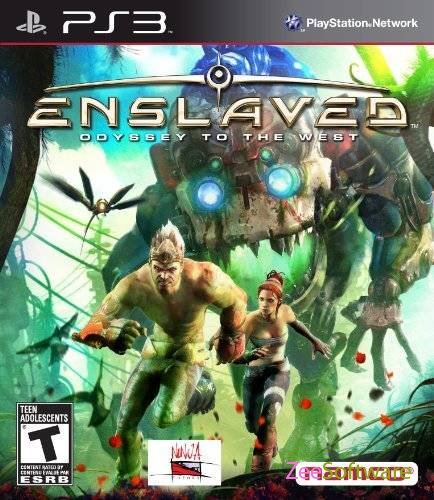
15. Enslaved: Odyssey to the West – This is probably one of the more overlooked titles of this generation, while not very technically impressive (gameplay-wise) this is still very much worth your time, and offers the best take on dystopian storytelling I’ve seen in a very long while, and what it lacks in gameplay, it makes up for in presentation and depth.


16. Batman: Arkham City – While I felt that Arkham Asylum was the best take on Batman in the video game world, I never thought it was an experience that couldn't be topped. Arkham City is a superior title in almost every way, narrative, scope, tone, and presentation. The Arkhamverse in and of itself is one of the best adaptations I've ever seen.


17. Final Fantasy VII – Final Fantasy VII is one of the most loved and hated RPGs ever made, with the latter group claiming it to be overrated. I can agree with them to an extent, but Final Fantasy VII still remains one of the most thematic and aesthetically balanced turn-based RPGs to date. Combined with Nobuo Uematsu's always impressive score, it's an experience few can turn away from.


18. Jak 3 – Naughty Dog took a big risk with Jak 2’s massive tonal shift from The Precursor Legacy, but it worked for the better, and they delivered with two surprisingly fantastic sequels, this one being the more favorable in my opinion. Whereas Jak 2 had very unforgiving checkpoints few and far between segments of the game as well as difficulty spikes, Jak 3 seems to have aged better with its more balanced progression, gun upgrades and contrast of Haven City and the Wasteland. And no, The Lost Frontier doesn't count.


19. Mega Man X – I have a mild respect and interest to the classic Mega Man titles but honestly Mega Man X was far superior to me in gameplay, scope, and execution, it took a basic formula and made it what it should have been in the first place.


20. Fable II – While Peter Molyneux has pretty much become a parody in and of himself, I was lucky enough not to be enveloped by the ridiculous advertising for the original Fable, and so I never built up ridiculous expectations for it, and quite enjoyed it for what it was. While I was initially skeptical, Fable II, while flawed, still succeeds its predecessor from a storytelling standpoint, more fluid and accessible melee combat as well as magic (Will) utilization and a fresh new time period and aesthetic that surprisingly works.


21. Sly 2: Band of Thieves – To keep things fair, I’m sticking to one game per franchise or series, and Sly 2 was the strongest of the now classic trilogy, improving upon Thievius Raccoonus and topping it every step of the way. Bentley and Murray as playable characters were varied and new minigames and gimmicks help keep the momentum going forward.


22. Chrono Trigger – When people talk about how “perfect” Skyrim is I tend to just roll my eyes (though I do love the game) and point at this beautiful title when it comes to RPG perfection. Akira Toriyama character design, SquareSoft developed engine, time travel, memorable characters, brilliant storytelling and intuitive combat. I got into this title relatively late, never playing it when I had a Super Nintendo nor buying the DS port. Even without the novelty, I still felt this was a flawless experience overall.


23. Dragon Ball Z: Budokai Tenkaichi 3 – I remember when developers actually put effort into these titles, Budokai Tenkaichi was the ultimate DBZ experience of the gaming world, boasting 161 characters, not counting their various transformations, alternative costumes and battle-damage directly imitating the events of the series and one of the most complicated yet addicting fighting engines I know. With this and the previous entries on the list there seems to be a pattern of progressive laziness after the third effort.


24. SoulCalibur III – Before SoulCalibur IV broke my heart, I played this game non-stop when I first bought it, solid fighting engine mixed with a ton of content such as an RTS-style alternative story mode, a detailed character creation mode, and the most well-handled story and bonuses of the series to date. It seems that Namco has stopped caring for every sequel afterward.


25. Pokemon Emerald – Hoenn has always been my favorite generation mostly due to the aesthetic and innovations such as diving and new inclusions such as Team Magma and Aqua and the first time the otherwise simple story has been elevated to a sense of importance with the Groudon, Kyogre, and Rayquaza subplot. Hoenn as a region was just so full of life and variation, as well as some great Pokemon, in my opinion it was Nintendo and Game Freak's peak of creativity before they fumbled the ball with Sinnoh.

Saturday, March 3, 2012

The Elder Scrolls V: Skyrim (PS3) - Review


Let’s talk about one of the most overrated games in recent memory. I have no grudge against Bethesda, in fact I tend to thoroughly enjoy their games, and this one is no exception. However, just because I enjoy the game doesn’t mean I don’t feel it gets a little more praise than it deserves. Role-Playing Games encompass my favorite genre in video gaming, I love being captivated and immersed in new worlds and new environments with three-dimensional characters that carry an impressive narrative throughout. Bethesda has garnered immense popularity thanks to The Elder Scrolls and Fallout, both of which usually get a hefty amount of praise whenever a new title from either series is thrown out into the public. The Elder Scrolls IV: Oblivion was a flawed but impressive experience, much like Skyrim now. Personal bias towards dystopian storytelling aside, Fallout 3 was just a more in-depth title, simple as that. Oblivion and Fallout 3 were given unanimous praise so you can debate amongst yourselves which is the superior title, I have my opinion, and you have yours.


Skyrim takes place two hundred years after the events of Oblivion, and involves the numerous adventures of you, the Dovahkiin, or Dragonborn. You as the Dragonborn, affect the fate of the land of Skyrim as dragons have returned to the lands after supposedly being extinct for centuries. As a Dragonborn, you wield the power of Thu’um, a Dragon Shout, in which you utilize words of the dragon language into various shouts, examples including Unrelenting Force (basically Force Push from the mouth), among others. Despite my criticisms to come, I love this concept for its originality and prominence to both gameplay and plot.

From a technical standpoint, Skyrim is ultimately a more fine-tuned and improved version of its predecessor. This is to be expected of course, being the next installment. Ultimately though, I feel Oblivion could have been Skyrim (for the most part) when it was out... six years ago. The melee combat still needs tweaking and a bit more fluidity to bring it beyond what’s already been established in Morrowind and Oblivion as well as lesser-loved titles such as Dead Island. Thankfully, the leveling system has been much improved from its very counter-intuitive origins. Shouts are a welcome gameplay mechanic with both variety and viable application. Dialogue-branching is fairly underwhelming and inferior to titles such as Dragon Age: Origins and Fallout 3. Being that Bethesda’s games focus on a single character, I can slightly excuse the lack of memorable characters considering the game is centered on you as a player.

However, when it comes to an in-depth role-playing experience, other characters help carry the narrative and offer much-appreciated gravitas to the overall drama. The fact of the matter is that the majority of the NPCs in this world are uninteresting, useful only for offering quests or exposition on the lore, which I can expect and accept from an MMO, but not this. Aside from minor touches, the graphics aren’t very impressive, and it would seem that the engine seems a tad dated in the same way the Source Engine seems to be for Portal 2. Fighting dragons is initially exciting but quickly becomes straightforward and monotonous considering the embarrassing A.I.

Praise goes to exploration and size in terms of how massive Skyrim really is. I sometimes find it more interesting to journey out into the unknown rather than clumsily swing a sword at a troll or Frostbite Spider. While combat could use some work, magic execution is relatively solid and dual-wielding is always a nice touch. The quests are varied and interesting but towards the end of the game dungeons start to become noticeably padded. Make no mistake, this is an intriguing world but the main storyline doesn’t seem to live up to its full potential, and therefore undermines the setting more than it should.


Generally speaking, it’s easy to compare how different companies handle their genres. I think this even more prevalent for RPGs in particular, considering the tact and amount of creative license that applies, more so than say an FPS or platformer. RPGs are thankfully one of the best genres for storytelling in the medium, and aside from a few tropes, they’re very flexible. I’ve always stood by the opinion that Pokémon is a great introduction to RPGs, especially for younger players. Nintendo handles their long-going franchise with simplicity and variety, the different Pokémon teach a player unfamiliar with the genre how to utilize different stats and assemble an effective party, which applies to the majority of most turn-based titles. Bethesda tends to focus more on scale and scope than actual context, and while the context is pleasing, it’s quite lackluster compared to its competition as well as games released years before it. BioWare tends to establish a happy medium with context and scope as well as gameplay (when they’re not embarrassing themselves with Dragon Age II). Then again, character weight to the narrative is part of the appeal in their titles.

My critical point is that Skyrim succeeds so well in its impression that general players tend to look past it’s very visible flaws and go so far as to call it perfect or even one of the most revolutionary RPGs to date, which isn’t the case at all. I found Skyrim to be quite an enjoyable and addictive experience, putting in over 100 hours into it on my own playthrough. That being said, this is far from a flawless experience, and Bethesda still has a lot to learn before they get there, but as it stands, it’s well worth the cash and time I put into it, aside from the bugs and glitches Bethesda is slightly infamous for. 8 out of 10.

Friday, February 24, 2012

The Tree of Life - Review


Terence Malick’s work is already synonymous with art house films at this point, so The Tree of Life being what is comes as no surprise to me. You’ve probably already heard about the beauty and the scope from the positive crowd, and the pretense and tedium from the other end. If you follow Brad Jones’s vlogs at all, you’ll know he doesn’t much care for films like this. I on the other hand, am neither for nor against them. If it does it well, I commend it and if it doesn’t then I don’t, simple.  The Tree of Life begins with a mysterious and mesmerizing light resembling a flame with Mrs. O’Brien debating two paths in life, that of grace and that of nature, we see her in the 1960s (played by the stunning Jessica Chastain) receiving a telegram informing her of the death of her nineteen year old son, R.L. Soon after, Mr. O’Brien (Brad Pitt) receives a call from his wife who notifies him of the recent tragedy. The family is now disheveled, and Jack O’Brien (Sean Penn) is lost in thought and internal debate between his mother and father’s paralleled but dissimilar philosophies: grace and nature.

In the midst of his inner disorder, Jack eyes a newly planted tree outside of his work place; he looks back at his childhood and family life. His father is strict, abrasive, and harsh while his mother is understanding and nurturing. We see life through the eyes of a child, and therefore empathize with Jack’s confusion and grudge toward his father and when he later goes through a rebellious phase. When Mr. O’Brien is away on business, it’s happy days for the children, they frolic, they play, and they make fun of their father’s authority like any group of kids would. As we progress through Jack’s experiences we as an audience are taken through a cosmic journey of life, including the formation of the universe and the transition from the molten and barren Earth to the evolution of sea life and the end of dinosaurs.

However, this trip is not completely devoted towards scientific fact, as the film also explores religious perception and the like. Perception is the operative word. We are not bound to a single way of thinking, for life in and of itself is a strange and interstellar series of events to which we are still learning so much about. It’s not about the ideals of an agnostic or a scientist or a priest, it’s about the mystery, and it’s about faith in the simplest sense, without obligation. You can debate the necessity of abundant symbolism until your blue in the face but the fact of the matter is that we ponder these mysteries every day, even when we’ve matured and seasoned after many a decade we still have questions unanswered.

On a technical standpoint, I’m surprised a film like this wasn’t shot or presented in 3-D, because the cinematography and craft are stunning, coupled by spectacular visuals and some mesmerizing choice of music pieces, one example being the best iteration of Lacrimosa I’ve ever heard, Lacrimosa 2 by Zbigniew Preisner, it’s so beautiful it almost haunts me. This is less a film and more an orchestra, an abundance of scenery that has continuously echoed throughout every corner of my mind. This must have been quite a theater experience. The performances are commendable, thankfully not being overshadowed by the aesthetic or point (for the most part). I praise Jessica Chastain for her angelic portrayal and Brad Pitt for his seamless model of the times. With respect to the late Stanley Kubrick, The Tree of Life is a film much like 2001: A Space Odyssey, but handled better. 8 out of 10.

Monday, February 13, 2012

Safe House - Review


Is it too late for Ryan Reynolds to go back to comedies? Honestly, I can never take him seriously in other roles. I don’t know if it’s his voice, or if I just find him so funny in his comic schtick. While he may have been an alright Hal Jordan (still holding out for Nathan Fillion in the inevitable reboot), Ryan Reynolds is just not an action star to me. Denzel Washington on the other hand, is a jack of all trades. Safe House chronicles Matt Weston (Reynolds) on his chase to turn Tobin Frost (Washington) into the authorities. Frost is an ex-CIA operative who has acquired classified files and has been labeled a traitor to the U.S. government. Frost is detained in a safe house where Weston acts as his guardian until the base is attacked and Frost is able to escape from Weston’s custody, and the film progresses into textbook clichés, predictable revelations, and plenty of eye-rolling from myself.

An unfortunate but abundant gimmick in action films from recent memory is the use of shaky-cam to express spectacle or urgency; I don’t mind utilizing it as a technique as long as it doesn’t become excessive. In this particular case, ungodly excessive would be an understatement. I find it funny that directors like Rob Cohen are subtler than this. A person sitting in a car giving exposition does NOT advocate the use of obnoxious camerawork trying to pass for dramatic conveyance. Say whatever you want about the Bourne Trilogy, those three films have more merit than most action films released in the last decade. Also on the technical side, this film has an obsession with focus reveals and unneeded zooms. This is the first time I have heard of Daniel Espinosa, he hasn’t been around for long and I feel like I need to donate him a tripod like he was a hobo who desperately needed a sandwich.

The story is a mess, going off in all directions, not settling on what it wants to be. The initial premise was intriguing but the strongest aspects of it are already shown in both the trailer and very beginning of the film. The script is so stale and lifeless that I give praise for Washington for actually bringing much appreciated gravitas to and otherwise forgettable role. Reynolds on the other hand is just as bland and stilted here as Sam Worthington in well... anything but Avatar. Believe it or not there are other characters woven into the narrative but they’re so forgettable they’re not worth a mention, including a generic subplot involving Weston’s girlfriend.

It’s honestly kind of hard to continue talking about a title like this. It’s so empty and run-of-the-mill it’s like trying to review a bottle of water, it’s wet, and it doesn’t have a distinctive taste to commend, it’s just water. Water is water, action schlock is action schlock. It’s not offensive, it’s just completely boring. 4.5 out of 10.

Friday, February 10, 2012

Drive - Review


Imagine if someone like Michael Mann directed movies like The Transporter or The Fast and the Furious, and then imagine if the production began and ended in the 80s. Bearing those two prerequisites in mind, you could imagine that films in that spirit would be much different than what we’re already associated with. Now if you can picture an interesting result from the aforesaid scenario, then you are more ready for Drive than you would be from its trailer alone.

Drive is a film that chronicles the nameless driver-for-hire played by Ryan Gosling. He’s a man of few words, speaking only when necessary; he is calm, and hard to read. He brings memories of The Man with No Name though without the less than subtle scowl and glare. Gosling invokes a sense of mystery and depth extremely simply but to great effect. I have honestly known people with similar personalities, and Gosling mirrors seamlessly from the voice, the inflections, his smile and the timing and context of all three. As his days go on, he becomes involved with his neighbor Irene (Carey Mulligan) and her son, forming a bond with the both of them. Shannon (Bryan Cranston), his daytime boss borrows money from mob boss Bernie Rose (Albert Brooks) to buy a stock car and back The Driver as well... his driver. But, when an operation involving Irene’s husband goes south, The Driver runs into trouble with both Bernie and Nino (Ron Perlman). Believe it or not, the plot is not the main crux or pull of the film, at least in a basic sense.

Generally speaking, I don’t get overhyped for productions aside from those that may apply to my personal preference or pleasure, such as comic book films. However, even at that it’s more overexcitement than ridiculous expectations. Prior to watching the film, I had little to expect. I just knew it was a new film with Ryan Gosling, who has been garnering progressively more publicity, and that apparently the trailer was slightly misleading, and it was actually an art picture. Drive is an art house film, and as such, has a sense of atmosphere and gravitas not (at least not usually) found in general blockbusters. Although the trailer may be misleading, Drive is by no means another Gone in 60 Seconds or The Fast and the Furious, unless you added the restrictions I mentioned before. Nicolas Winding Refn directs this project with subtlety and grit, and Newton Thomas Sigel provides us with stunning, emotional cinematography reflecting The Driver’s earnest persona.

Albert Brooks, typically known for his comic ingenuity, instead shocks viewers with a very dark but very nonchalant portrayal of Bernie, and does so without missing a beat. Carey Mulligan is far from deep but she works for the film’s narrative, which goes the same for Ron Perlman, who I felt was just going through the motions. Christina Hendricks has a minor role as Blanche, and does well despite a small part. Overall it’s a solid cast, my critique of Irene is not meant to be interpreted as a cliché female romantic interest. She is humble, kind, and lights up a scene, but in the same “spinning straw into gold” manner as The Driver. From this, their chemistry feels natural, and their interactions are handled realistically. A strong point for me was Irene’s husband, written as a man who fell from grace and legitimately wants to atone for it, as opposed to an abusive, throwaway device to further glorify The Driver and justify a relationship between him and Irene.

Less in the spirit of modern action and more in the spirit of 80s crime and neo-noir, Drive is a breath of fresh air for American cinema, not to say that I think the entire industry is lackluster. The film is slow, powerful, and elegant, and I am ashamed that Sound Mixing is the only Oscar nomination it received. Although I’ve only seen The Artist out of the Oscar nominees, Drive is my best film of 2011. The fact that Gosling and Brooks were snubbed for Best Actor and Sigel for Best Cinematography saddens me. But hey, at least the YOUReviewers awards acknowledge it. Hell, I didn't even talk about the soundtrack. Oh boy. 9 out of 10.

Thursday, February 2, 2012

J. Edgar - Review


Being a person who has written film reviews before, I have to admit that biopics are a little more difficult to write about. However, I do feel that a biopic should succeed in three areas. First off, it should be relatively accurate (dramatic license withstanding of course). Second, casting the right actor or actress is essential to portray the person in question correctly. Third, the narrative should not be one-sided, no exceeding glorification and no overabundance of ridicule or disdain, I would say that J. Edgar fulfills the aforementioned prerequisites, but everything else is up for debate.

J. Edgar is a biographical feature about J. Edgar Hoover, the man who brought the “F” to the FBI. The film is directed by Clint Eastwood and stars Leonardo DiCaprio in the titular role. The first thing I noticed when the film began was its detached, gray-toned cinematography, extremely similar to Gran Torino and Million Dollar Baby, also directed by Eastwood. I was sure that all three films had the same Director of Photography, and after checking IMDb, it seems I was correct. Reception for the film has been mixed, and I can understand why, it’s a perplexing piece.

To get some of the history out of the way, J. Edgar Hoover was a man of controversy. He frequently fired agents on appearance alone, he was outspoken, openly abrasive, and an alleged homosexual, things all touched upon in the film’s narrative. The man was also jealous to the point of irrationality; one of his better-known displays of said bitterness was his hand in progressively ending Melvin Purvis’s career solely because of his success and public recognition, also touched upon. What the film did right was cast DiCaprio as Hoover, who brings his A-game to the production, and may very well dishearten anyone who doubted his abilities before. I believe this performance completely solidifies him as an actor, and that microscopic bit of superficial pretty boy persona from Romeo + Juliet and Titanic has finally been washed away. From a writing perspective, it’s well conceived, though the final product is a bit jumbled in its execution.

The atmosphere was too melodramatic for its own good, and while I never felt confused at any point in the plot, the poor transtions through time were conspicuous enough for me to sympathize with general audiences. Thankfully, the homosexuality aspect is handled with a lot more subtlety than you may expect, but it doesn’t come full circle as much as it could due to Clyde Tolson’s very transparent portrayal. Coupled with less than stellar make-up and a cringe-worthy, bittersweet conclusion, J. Edgar in and of itself is a mixed bag. It’s not a bad film, but not a great one. It’s flawed. 6.5 out of 10.